Planning Guides
Best Cruise Cabins: Location Strategy by Deck and Position
Short answer
What do you actually need to know?
The best cruise cabin for most people is midship on a middle deck: lowest motion, moderate walk to everything. Avoid anything directly under pools and buffets, above theatres and nightclubs, or near crew doors and lifts. Balconies earn their premium on Alaska and Mediterranean sailings and are skippable on port-heavy Caribbean runs.
Key takeaways
- Motion is lowest midship and on lower decks; the pivot effect makes forward cabins move most.
- The noise map matters more than the view: check what is directly above and below before booking.
- Balconies are worth most in Alaska and scenic regions, least on port-heavy warm itineraries.
- Guarantee fares surrender position entirely, which is exactly what this page argues against.
- The quiet value categories: aft balconies, Deck 8 midship anywhere, and obstructed-view balconies at ocean-view prices.
Two cabins in the same category on the same ship can deliver different holidays. One sits midship on Deck 8 under another cabin deck: silent, stable, perfectly placed. The other sits under the pool deck at the bow: chairs scraping at dawn, maximum motion in any swell, and the same price.
Cruise lines price cabins by category and, crudely, by deck height. They do not price the noise map or the motion physics, which means informed buyers get systematically better cabins at identical prices.
This page is the deck plan reading you do before paying: where ships move, where they make noise, when each category earns its premium, and the handful of positions that quietly outperform their price.
The motion map: midship, low, and why
A ship in swell pitches around its centre, like a seesaw around its pivot. Cabins at the centre of the seesaw, midship, move least; cabins at the bow move most, with the stern in between. Height amplifies everything: each deck up adds lever arm to the same rotation.
The practical ranking, most stable to least: midship low, midship high, aft low, aft high, forward low, forward anything. On a calm Caribbean week the differences barely register; on an Atlantic crossing or the Drake Passage they are the difference between dinner and the cabin ceiling.
If anyone in the party worries about seasickness, buy midship on Decks 5 to 8 and spend the savings on the seasickness kit you will probably never open.
- Midship, Decks 5 to 8: the stability sweet spot on any ship.
- Forward cabins move most; avoid them for rough regions and nervous stomachs.
- Height amplifies motion; the fancy high decks are the movier decks.
- Bigger ships move less, but position still beats vessel size for comfort.
The noise map: what is above, below and beside you
The deck plan check that prevents most cabin regret: look at what sits directly above and directly below your cabin. The safe answer is other cabins both ways. The dangerous answers above are pools, buffets, gyms and sports courts, all of which generate dawn noise: chairs dragged, weights dropped, deck washed. The dangerous answers below are theatres, nightclubs and galleys, which generate midnight noise instead.
Horizontal neighbours matter too: cabins beside lift lobbies collect corridor chatter, cabins opposite crew service doors collect 5am cart traffic, and connecting-door cabins share more sound with their neighbour than standard walls do.
Aft cabins near the engine spaces pick up vibration at manoeuvring speeds; light sleepers notice, heavy sleepers never do.
| Position | Problem | When it strikes |
|---|---|---|
| Under the pool deck | Chair dragging, deck washing | 5.30am to 8am |
| Under the buffet or gym | Trolleys, treadmills, weights | Early morning |
| Over the theatre | Bass and applause | 8pm to 11pm |
| Over or beside the nightclub | Bass until close | 10pm to 2am |
| Opposite crew doors | Service carts | Early and often |
| Beside lift lobbies | Corridor conversation | Constant |
| Far aft, low decks | Engine vibration | Manoeuvring and docking |
When each category earns its price
Interiors are the value engine of cruising: the whole ship is identical beyond your door, and on a port-heavy itinerary where the cabin is for sleeping, the balcony premium buys excursions instead. They are also the darkest rooms afloat, which night-shift workers and nappers consider a feature.
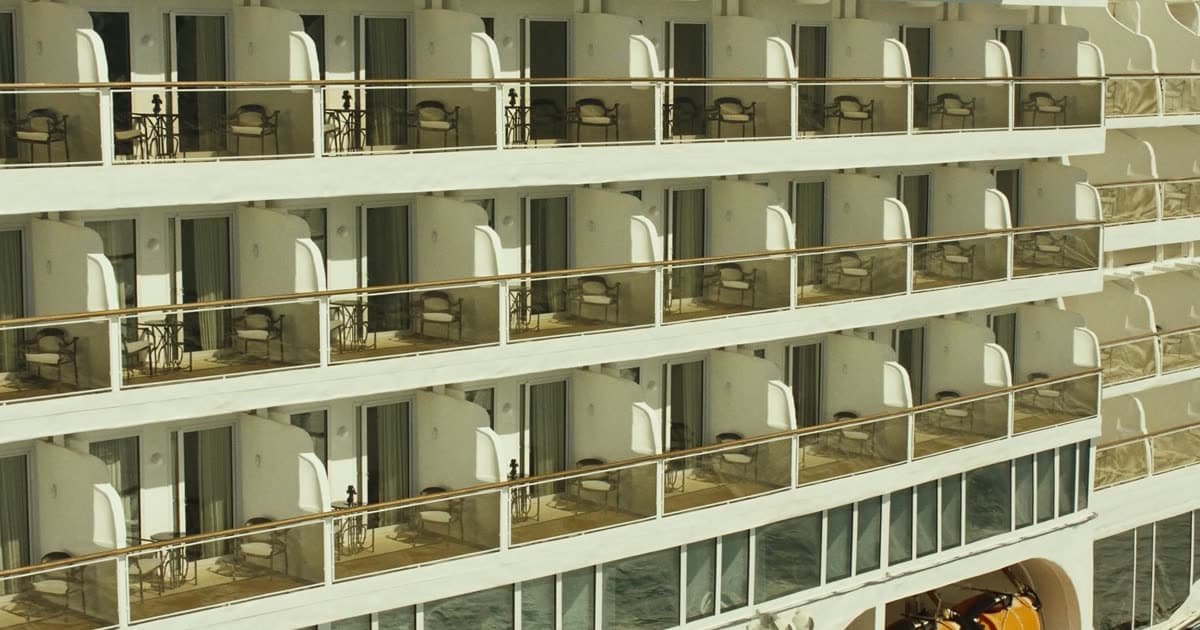
Ocean views price awkwardly: several hundred dollars over interior for a sealed window. The exception is the obstructed-view balcony, sold at ocean-view prices with a lifeboat partially blocking a real, opening balcony: the quiet bargain of most deck plans.
Balconies earn their premium where the scenery comes to you: Alaska, Norway, the Panama Canal, Mediterranean sailaways. On Caribbean runs they are lovely and skippable. Suites price for space and perks, priority lines, lounges, better service ratios, and make most sense on long itineraries where the perks compound daily.
- Interior: the budget play; identical ship, darkest sleep, biggest savings.
- Obstructed balcony: real balcony, lifeboat view, ocean-view price; the deck-plan bargain.
- Balcony: worth it where scenery passes the ship, skippable where it does not.
- Aft-facing balcony: the connoisseur pick; wake views, larger size, no wind.
- Suite: buy it for the perks on long cruises, not the square footage on short ones.
Booking the good position
Book the specific cabin, not the category: most lines let you choose the exact cabin at booking, which is where everything above gets applied. Guarantee fares hand position to the line for a discount, which is the direct opposite trade.
The good positions sell first: aft balconies, midship anything, connecting family cabins. Booking ten to twelve months out is a position strategy as much as a price one.
Before confirming, open the deck plan one final time: your cabin, the deck above, the deck below, the corridor. Ninety seconds against seven mornings of dragged chairs.
- Always select the exact cabin; never accept assigned-at-random for a good sailing.
- Book early for position; the informed cabins go before the fare moves.
- Final check: above, below, beside, on the actual deck plan.
- Same category, same price, different holiday: position is free value.
Terms worth knowing
- Midship
- The centre third of the vessel lengthwise, where pitching motion is lowest and every cabin position debate ends.
- Obstructed-view balcony
- A functional balcony cabin with a lifeboat or davit partially blocking the sightline, priced near ocean-view categories: the deck plan's standard bargain.
- Aft-facing balcony
- A stern cabin overlooking the wake, typically larger and better sheltered than side balconies, and rebooked by veterans before general inventory moves.
- Guarantee fare
- A discounted booking where the line assigns the cabin position, trading away everything this guide optimises.
| Itinerary | Balcony verdict | Why |
|---|---|---|
| Alaska | Essential | Glaciers and wildlife pass the ship all day |
| Norway and fjords | Essential | Continuous scenic cruising |
| Panama Canal | Strongly worth it | Transit day is the whole point |
| Mediterranean | Worth it | Sailaways and harbour arrivals reward it |
| Caribbean, port-heavy | Skippable | Days ashore, cabin for sleeping |
| Transatlantic | Skippable | Cold, windy, sea for days |
The cabin decision, in order
Position first, category second, price third.
Midship, Decks 5 to 8
Choose it when: Anyone aboard worries about motion, or the itinerary crosses open ocean.
Cabins sandwiched between cabin decks
Choose it when: Always; it is the only universally quiet position.
The balcony
Choose it when: Alaska, fjords, Panama Canal, Mediterranean. The scenery does the justifying.
The interior
Choose it when: Port-heavy Caribbean and tight budgets; identical ship, hundreds saved.
The aft balcony
Choose it when: One is available near standard balcony pricing; it is the best cabin most ships sell.
Put this research to work
Compare current fares against the numbers on this page, and check the related guides below before adding packages or excursions.
Speak to a cruise specialist. Daily, 8am to 11pm ET.
Frequently asked questions
What is the best cabin location on a cruise ship?
Midship on a middle deck, Decks 5 to 8, with cabins directly above and below yours. That position minimises motion, which pivots around the ship's centre and amplifies with height, and eliminates the standard noise sources: pools and buffets above, theatres and clubs below. Within that zone, an aft-facing balcony is the connoisseur upgrade.
Which cruise cabins should you avoid?
Anything directly beneath the pool deck, buffet or gym, which deliver dawn chair-dragging and treadmill noise; anything above or beside the theatre and nightclub, which deliver bass until closing; cabins opposite crew service doors and beside lift lobbies; and forward cabins on rough-water itineraries, where motion is greatest. The deck plan shows all of it in ninety seconds.
Is a balcony cabin worth it?
By itinerary. On Alaska, Norwegian fjord and Panama Canal sailings, where scenery passes the ship continuously, the balcony transforms the trip and is worth stretching for. On port-heavy Caribbean runs where the cabin is for sleeping, the $300 to $500 premium buys excursions instead. The obstructed-view balcony, priced near ocean-view, splits the difference.
Do lower decks feel less motion on a ship?
Yes. Ships pitch around their centre of rotation, and height acts as a lever arm amplifying the movement, so a Deck 12 forward cabin swings substantially more than a Deck 5 midship one in the same swell. For motion-sensitive travellers the ranking is midship-low first, forward-high last, and it holds on every ship afloat.
What is a guarantee cabin and should you book one?
A discounted fare where you choose only the category and the line assigns the specific cabin, potentially anywhere: under the pool, at the bow, beside the crew door. The discount is real and the trade is exactly the position value this guide describes. Take it on calm itineraries when saving matters; never take it if noise or motion sensitivity is in play.
Why do experienced cruisers book aft balconies?
They are the deck plan's quiet outperformers: larger than equivalent side balconies, sheltered from the headwind that makes forward balconies unusable at sea speed, and holding the wake view, which is the most watchable scenery on the ship. They sell out early precisely because past guests rebook them, which is itself the recommendation.
About the author
Senior Cruise Editor
Mara Vance has been writing about cruise travel since 2011, first for a regional newspaper travel desk and, since 2019, as the senior editor at BestCruiseDeals.us. She sets the review framework every cruise line page on this site is scored against.
71 sailings logged across 10 cruise lines.
This page was fact-checked by Captain Alberto Ruiz, marine and operations reviewer, on . Prices and policies are re-checked against cruise line sources at least every 90 days. Read our editorial policy.