Asia · Cruise destination guide
Japan Cruise Guide: Cherry Blossom, Autumn Colour and Ports
Short answer
What should you know before booking a Japan cruise?
Japan has two cruise peaks: cherry blossom from late March to mid-April and autumn colour in late October and November. Both sell out a year ahead. Many Japanese cruise ports sit an hour or more from the city they serve, so port days need planning. Balcony fares run $185 to $340 per person per night. Book the blossom and autumn windows a year out or plan deliberately around them. The rail network makes independent port days unusually practical, and with ship excursions here often priced at several times the train fare, doing Japan independently saves hundreds per couple across a week.
Key takeaways
- Two peak seasons: cherry blossom in spring and autumn colour in November.
- Cherry blossom timing moves by up to two weeks year to year and cannot be guaranteed.
- Many ports are 45 to 90 minutes from the city they are named for.
- Typhoon season runs roughly July to October and causes real itinerary disruption.
- Japan is cash-friendlier than most developed countries; carry yen.
Overview
Japan has become one of the fastest-growing cruise regions in the world, and it is unusual in having two distinct peak seasons that book out a year in advance for entirely different reasons.
Cherry blossom season runs from late March in Kyushu to mid-April in Hokkaido, moving north as a front. Cruise lines schedule itineraries against the historical average, but the actual bloom shifts by up to two weeks year to year. Booking a cherry blossom cruise is buying a good probability, not a guarantee, and any line promising otherwise is overselling.
Autumn colour in late October and November is more predictable and, in our reviewers' view, at least as beautiful. It is also slightly cheaper and less crowded, which makes it the better booking for most travellers.
Japanese itineraries typically run seven to fourteen nights from Yokohama, Tokyo, Kobe or Osaka, with some sailings continuing to South Korea, Taiwan or Russia's far east historically.
The single most important practical fact is that Japanese cruise ports are frequently a long way from the cities they serve. Yokohama is 45 minutes from central Tokyo. Kobe is 30 minutes from Osaka and an hour from Kyoto. Shimizu is 20 minutes from nothing in particular but has a superb Mount Fuji view.
Japan's rail network makes independent port days genuinely practical, more so than almost anywhere else in Asia. Trains are punctual to the minute, signage is bilingual in cities and an IC card works across most networks. Ship excursions in Japan are expensive and often unnecessary.
- Two peak seasons: cherry blossom and autumn colour.
- Ports are frequently 45 to 90 minutes from the city they serve.
- Japan's rail network makes independent port days unusually practical.
- Typhoon season from July to October causes genuine itinerary disruption.
The best time to go
Late March to mid-April for cherry blossom, late October to November for autumn colour. Those are the two reasons to cruise Japan and both are worth planning around.
May and June are pleasant, quiet and much cheaper, though June brings the rainy season to much of the country. September and early October carry typhoon risk but deliver warm weather and low fares.
| Month | Weather | What is happening | Fares | Verdict |
|---|---|---|---|---|
| Late March to April | 52 to 66F, mild | Cherry blossom, moving north | Highest | The headline season; book a year ahead |
| May | 64 to 73F, pleasant | Fresh green, festivals | Moderate | Excellent weather without the crowds |
| June | 70 to 77F, rainy season | Hydrangeas | Low | Wet but cheap and very quiet |
| July to August | 82 to 90F, humid | Summer festivals, typhoon risk | Moderate | Hot, humid and disruption-prone |
| September to early October | 75 to 82F | Typhoon season peak | Low | Good value with real disruption risk |
| Late October to November | 57 to 70F, clear | Autumn colour, moving south | High | The best month, and more reliable than spring |
| December to February | 40 to 52F, cold | Winter illuminations, snow in the north | Lowest | Cold but very cheap and atmospheric |
The ports, honestly assessed
Japanese ports vary enormously in convenience. The transfer time is the number that determines your day, and it is often longer than passengers expect.
YokohamaJapan
The main Tokyo cruise port, 45 minutes from central Tokyo by train. Yokohama itself has an excellent waterfront and Chinatown.
KobeJapan
The port is in the city. Kyoto is 60 minutes and Osaka 30 by train. The best-placed port for the Kansai region.
NagasakiJapan
The port is central and walkable. The Atomic Bomb Museum and Peace Park are essential and accessible by tram.
HiroshimaJapan
Ships dock at Ujina, 20 minutes by tram from the Peace Memorial. Miyajima and its floating torii are a 40-minute ferry.
ShimizuJapan
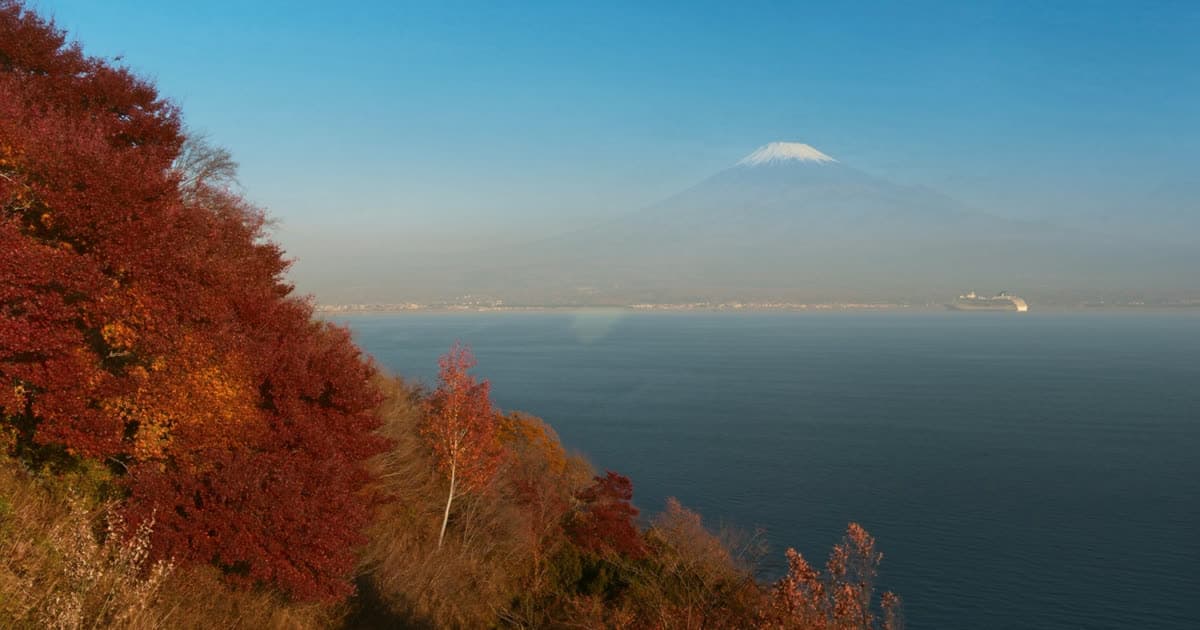
The best Mount Fuji view from any Japanese cruise port on a clear day. Little else nearby.
KagoshimaJapan
Sakurajima volcano is directly across the bay and often actively venting. A short ferry gets you to its base.
OsakaJapan
Tempozan terminal is central. Kyoto and Nara are both under an hour by train.
HakodateJapan
Southern Hokkaido. The morning market is a five-minute walk and the Mount Hakodate night view is famous.
AomoriJapan
Northern Honshu. The Nebuta Museum is a five-minute walk and Hirosaki Castle is a superb cherry blossom site.
Okinawa, NahaJapan
Subtropical and culturally distinct. Shuri Castle and the Churaumi Aquarium are the two draws.
BusanSouth Korea
Frequently paired with Japanese itineraries. Gamcheon Culture Village and Jagalchi fish market are the highlights.
Weather, month by month
Japan spans 1,900 miles from subtropical Okinawa to subarctic Hokkaido, so national averages are misleading. The figures below are for the Kansai and Kanto regions, where most ports sit.
| Month | High | Low | Sea | Rain days | Notes |
|---|---|---|---|---|---|
| March | 55F | 40F | 57F | 10 | Cherry blossom begins in Kyushu late in the month. |
| April | 65F | 50F | 60F | 10 | Peak cherry blossom through central Japan. Highest fares. |
| May | 73F | 59F | 66F | 10 | The most pleasant weather of the year and much cheaper. |
| June | 78F | 67F | 71F | 15 | Rainy season. Wet, humid and very quiet. |
| July | 85F | 74F | 77F | 13 | Hot and humid. Typhoon season beginning. |
| August | 88F | 76F | 81F | 11 | Peak heat. Summer festivals are excellent. |
| September | 82F | 71F | 80F | 13 | Peak typhoon month. Itinerary changes are common. |
| October | 72F | 60F | 75F | 11 | Typhoon risk falling. Autumn colour begins in Hokkaido. |
| November | 63F | 50F | 69F | 8 | The clearest month. Peak autumn colour in central Japan. |
| December | 53F | 41F | 63F | 6 | Cold and dry. Winter illuminations, lowest fares. |
What it actually costs
Japan cruise fares run above the Mediterranean and below Alaska. The main variable is season: a cherry blossom sailing costs 40 to 60 percent more than the same itinerary in May.
Port-day costs are moderate and independent travel is cheap. A day trip from Kobe to Kyoto by train costs about 2,500 yen return, against $180 for the equivalent ship excursion.
| Cost item | Budget, May | Mid-range, November | Premium, cherry blossom |
|---|---|---|---|
| Cruise fare, per night | $115 to $160 | $185 to $250 | $300 to $480 |
| Line and cabin | MSC or Royal Caribbean, interior | Princess or Celebrity, balcony | Oceania, Silversea or Regent |
| Flights from North America | $900 to $1,600 | $1,100 to $1,900 | $1,400 to $2,400 |
| Pre-cruise hotel, three nights in Tokyo | $330 to $520 | $450 to $780 | $780 to $1,500 |
| Taxes and port fees | $280 to $400 | $300 to $440 | $320 to $480 |
| Gratuities | $132 to $192 | $204 to $252 | Often bundled |
| Independent port days or excursions | $250 by train | $800 to $1,400 | $1,200 to $2,000 |
| Realistic total | $3,300 to $5,000 | $5,100 to $7,800 | $7,300 to $12,500 |
Popular itineraries
Japan itineraries fall into four shapes, and the season matters more than the route.
Japan intensive, ten nights
from $2,250 per person
10 nights from Yokohama or Tokyo
Calls: Shimizu, Kobe, Hiroshima, Nagasaki, Kagoshima, Busan
Best for: The standard Japan circuit
Cherry blossom, twelve nights
from $3,600 per person
12 nights from Yokohama
Calls: Shimizu, Kobe, Hiroshima, Nagasaki, Aomori, Hakodate
Best for: Following the blossom front north
Autumn colour, twelve nights
from $2,820 per person
12 nights from Tokyo or Kobe
Calls: Hakodate, Aomori, Kanazawa, Kyoto via Kobe, Hiroshima
Best for: The most reliable and arguably prettiest season
Japan and South Korea, fourteen nights
from $3,080 per person
14 nights from Yokohama
Calls: Nagasaki, Busan, Jeju, Kagoshima, Okinawa
Best for: Adding Korea to a Japanese itinerary
Northern Japan and Hokkaido, eleven nights
from $2,530 per person
11 nights from Tokyo
Calls: Hakodate, Otaru, Kushiro, Aomori, Sendai
Best for: Cooler summer sailings and lavender season
Travel tips from our sailings
Book cherry blossom sailings a year ahead. They sell out earlier than any other cruise product in Asia.
Understand that blossom timing is a probability, not a promise. The front moves by up to two weeks between years.
Autumn colour in November is more reliable than spring blossom and costs 20 to 30 percent less.
Use the trains. A Kobe to Kyoto return costs about 2,500 yen against $180 for a ship excursion covering the same ground.
Buy an IC card such as Suica or ICOCA on arrival. It works on almost every urban transport network in the country.
Carry cash. Japan is more cash-dependent than most developed countries, particularly at temples, small restaurants and rural stations.
Check where your ship actually docks. Yokohama is 45 minutes from Tokyo and Kobe is an hour from Kyoto.
Typhoons between July and October do cause real itinerary changes. Buy insurance that covers itinerary alteration, not just cancellation.
Japan packing essentials
- Slip-on shoes. You will remove them at temples, some restaurants and any traditional accommodation.
- Layers for spring and autumn, when mornings and evenings are considerably cooler than midday.
- A compact umbrella; Japan sells excellent cheap ones everywhere but you will want one from day one.
- A small towel, since many public restrooms do not provide hand drying.
- Cash in yen, obtained from a post office or convenience store ATM, which accept foreign cards reliably.
- A Type A power adapter, which matches North American plugs at 100 volts.
- Modest clothing for temple and shrine visits.
The full list, including the banned-items rules, is in our cruise packing guide.
Terms worth knowing
- Sakura front
- The cherry blossom bloom line moving north through Japan at roughly 25 miles a day, reaching Kyushu in late March and Hokkaido in early May.
- Koyo
- Japanese autumn colour, moving south from Hokkaido in late September to Kyushu in early December, peaking in central Japan in November.
- IC card
- A rechargeable transport card such as Suica, Pasmo or ICOCA, usable on almost every urban rail and bus network in Japan and at convenience stores.
- Tsuyu
- Japan's rainy season, running roughly from early June to mid-July across most of the country, with high humidity and frequent rain.
| Factor | Cherry blossom, late March to April | Autumn colour, late October to November |
|---|---|---|
| Predictability | Low, shifts up to two weeks | High, shifts a few days |
| Fares | Highest of the year | 20 to 30 percent below spring |
| Crowds | Extreme at major sites | Busy but manageable |
| Weather | 52 to 66F, some rain | 57 to 70F, clearest skies of the year |
| Booking lead time | Twelve months | Six to nine months |
| Verdict | The famous one | The better one |
Which Japan cruise should you book?
Season dominates every other decision when cruising Japan. Start there and the rest follows.
An autumn colour sailing in November
Choose it when: You want the best combination of scenery, weather and price. Clearer skies, more reliable timing and 20 to 30 percent cheaper than spring.
A cherry blossom sailing
Choose it when: Blossom is genuinely the reason for the trip and you accept the timing risk. Book twelve months ahead.
A May sailing
Choose it when: Value matters. The weather is the best of the year and fares sit well below both peaks.
Plan independent port days
Choose it when: You are cruising Japan at all. The rail network is superb and ship excursions cost several times the train fare.
Avoid September
Choose it when: You have flexibility. It is the peak typhoon month and itinerary changes are genuinely common.
Price Japan sailings
Realistic mid-range trips run about $225 per person per night all-in. Check current fares, then verify against the cost table above before booking.
Speak to a cruise specialist. Daily, 8am to 11pm ET.
Japan cruise questions
When is cherry blossom season for a Japan cruise?
The blossom front moves north at roughly 25 miles a day, reaching Kyushu in late March, central Japan including Tokyo and Kyoto in early April, and Hokkaido in early May. Cruise lines schedule against historical averages, but actual timing shifts by up to two weeks year to year, so a cherry blossom cruise buys a good probability rather than a guarantee.
Is autumn better than cherry blossom for a Japan cruise?
For most travellers, yes. Autumn colour in November is far more predictable, November has the clearest skies of the Japanese year which also improves Mount Fuji sightings, crowds are more manageable, and fares run 20 to 30 percent below spring. Cherry blossom is more famous; autumn is the better trip.
How far are Japanese cruise ports from the cities?
Often further than expected. Yokohama is 45 minutes from central Tokyo, Kobe is 30 minutes from Osaka and 60 from Kyoto, and Hiroshima's Ujina terminal is 20 minutes by tram from the Peace Memorial. Shimizu is close to nothing but has the best Mount Fuji view of any port. Check the transfer before planning the day.
How much does a Japan cruise cost?
Twelve-night balcony fares run $185 to $250 per person per night in November and $300 to $480 during cherry blossom. Add flights of $900 to $2,400, a Tokyo hotel and port taxes. A realistic mid-range November total is $5,100 to $7,800 per person; a cherry blossom premium trip runs $7,300 to $12,500.
Should you book ship excursions in Japan?
Usually not. Japan has the best rail network in the world, trains are punctual and bilingual signage is good in cities. A Kobe to Kyoto return costs about 2,500 yen against roughly $180 for a comparable ship excursion. The exceptions are remote ports and any day where a long transfer would risk missing the ship.
Do typhoons affect Japan cruises?
Yes, genuinely. Typhoon season runs roughly July to October and peaks in September, and itinerary changes in that window are common rather than rare. Ships reroute for safety and port calls get substituted at short notice. If sailing in that period, buy travel insurance that covers itinerary alteration rather than only trip cancellation.
About the author
Ports and Destinations Writer
Lena Hartley covers the parts of a cruise that happen off the ship: departure port logistics, shore excursions, weather windows and whether a port call is worth leaving the ship for at all.
48 sailings logged across 8 cruise lines.
This page was fact-checked by Captain Alberto Ruiz, marine and operations reviewer, on . Prices and policies are re-checked against cruise line sources at least every 90 days. Read our editorial policy.