Cruise Types
River Cruises Explained: Europe, the Nile and the Mekong
Short answer
Is this style of cruising right for you?
River cruises carry 100 to 190 guests on vessels that dock in town centres rather than commercial ports. Fares run $350 to $700 per person per night and usually include excursions, drinks with meals and gratuities. The Danube and Rhine are the main European routes, with the Nile and Mekong the leading long-haul options.
Key takeaways
- Ships carry 100 to 190 guests and dock in the middle of towns, not at industrial ports.
- Fares of $350 to $700 per night usually include excursions, wine with meals and gratuities.
- Water levels are the main risk: high or low water can force coach transfers or ship swaps.
- Minimum ages of 8 to 12 make river cruising effectively adults-only.
- The Danube and Rhine are the busiest routes; the Douro and Rhone are the most scenic.
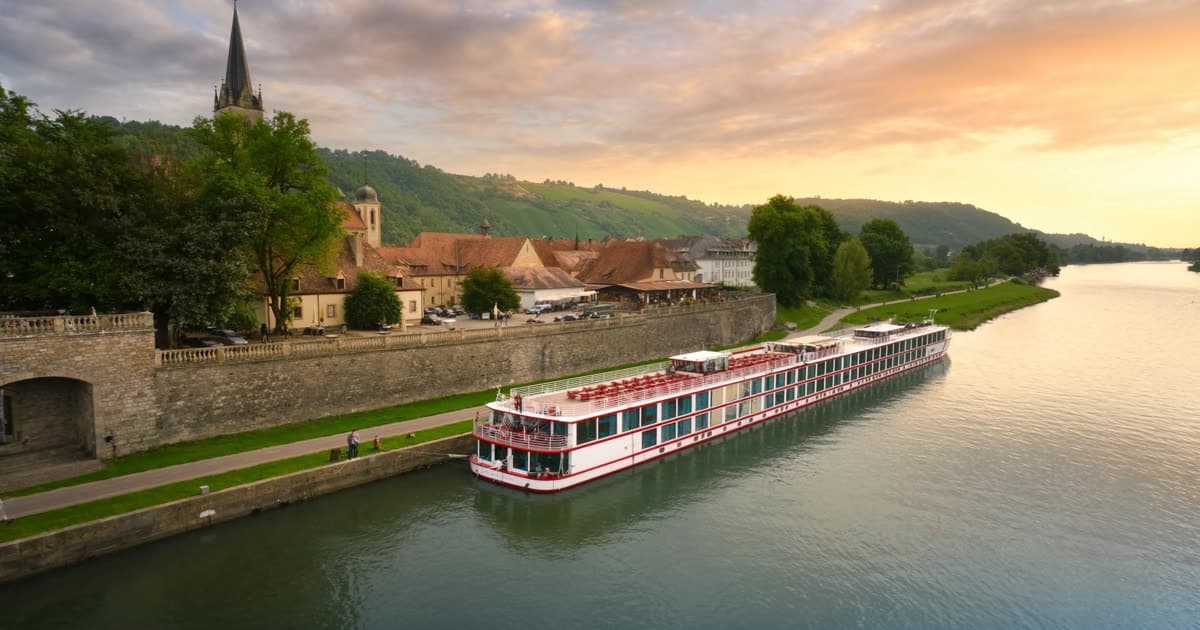
River cruising solves a specific problem: seeing a series of European towns without packing, unpacking and moving hotels. The ship carries 100 to 190 people, docks in the town centre, and you walk off into Vienna or Bamberg rather than taking a coach from an industrial port an hour away.
It is a fundamentally different product from ocean cruising, and comparing them on fare is misleading. A $500 per night river fare typically includes excursions in every port, wine and beer with meals, and gratuities, which on an ocean ship would add $200 per day.
The trade-offs are real. There is no pool worth the name, entertainment is a pianist and a lecturer, and water levels can disrupt an itinerary in ways that ocean cruising almost never experiences.
How river cruising actually differs from ocean cruising
The physical constraint drives everything. River vessels must pass under bridges and through locks, which fixes their dimensions at roughly 135 metres long, 11 metres wide and three decks high. That gives you 100 to 190 guests, no atrium, no theatre and no pool of any size.
What you get instead is location. The ship ties up in the centre of Passau, Bratislava or Bordeaux, and you step off into the town. Ocean ships calling at Civitavecchia put you 90 minutes from Rome; river ships put you at the cathedral steps.
The passenger profile follows: older, quieter, more interested in walking tours than water slides. The average European river cruise passenger is over 60.
| Factor | River cruise | Ocean cruise |
|---|---|---|
| Guests per ship | 100 to 190 | 600 to 5,700 |
| Docking | Town centre | Commercial port, often 30 to 90 minutes out |
| Fare per night | $350 to $700 | $95 to $960 |
| Excursions | Usually included | $60 to $250 extra per port |
| Drinks | Wine and beer with meals included | Extra or packaged |
| Gratuities | Usually included | $14.50 to $23.00 per day |
| Entertainment | Pianist and lecturer | Theatre, comedy, live music |
| Main risk | Water levels | Weather and port cancellations |
The main routes and which to choose
The Danube from Passau or Nuremberg to Budapest is the busiest and the best first river cruise: Vienna, Bratislava, Budapest, Melk Abbey and the Wachau Valley in a week, with easy flights.
The Rhine from Amsterdam to Basel is the other classic, with the Middle Rhine gorge and its castles as the scenic centrepiece. It is more industrial in stretches than the Danube.
The Douro in Portugal and the Rhone in France are the two most scenic and the two smallest. Douro ships are limited by lock size to about 100 guests, and the terraced vineyards are the most beautiful river landscape in Europe.
Beyond Europe, the Nile between Luxor and Aswan is the strongest long-haul river product, and the Mekong through Vietnam and Cambodia is the most culturally distinct.
- Danube: the best first river cruise, easiest logistics, Vienna and Budapest.
- Rhine: castles and the Middle Rhine gorge, more industrial in places.
- Douro: the most beautiful, smallest ships, terraced vineyards.
- Rhone: Provence and Burgundy, strong food and wine focus.
- Nile: Luxor to Aswan, the best long-haul river itinerary.
- Mekong: Vietnam and Cambodia, the most culturally distinct.
Water levels are the risk nobody mentions at booking
European rivers run too high in spring after snowmelt and too low in late summer during drought. When levels are wrong, ships cannot pass under bridges or float over shallows.
Operators handle it in three ways: swapping passengers between two ships moored either side of the obstruction, coaching guests to sights and back, or cancelling sections. All three happen every season, and 2018 and 2022 saw extensive disruption on the Rhine and Danube.
You cannot eliminate this risk, but you can reduce it. May, June and September have the most reliable levels. Late July and August are the highest risk for low water. Book with an operator that has a published water-level policy and buy insurance covering itinerary change.
- Spring snowmelt causes high water; late summer drought causes low water.
- May, June and September have the most reliable levels.
- Operators swap ships, coach guests or cancel sections when levels are wrong.
- Buy insurance covering itinerary change rather than only cancellation.
- Ask the operator for its published water-level policy before booking.
What a river cruise actually costs
River fares look high until you account for inclusions. A typical European river cruise at $500 per person per night includes an excursion in every port, wine and beer with lunch and dinner, gratuities and often airport transfers.
The comparable ocean cost is a $200 per night fare plus $150 per port in excursions, $60 per day in drinks and $18 per day in gratuities, which lands close to $400.
The genuine premium is real but smaller than the sticker suggests, and it buys a town-centre mooring every day.
| Cost item | Value operator | Mid-range | Premium |
|---|---|---|---|
| Fare per night | $350 to $450 | $460 to $580 | $600 to $700 |
| Cabin | Lower deck, fixed window | Middle deck, French balcony | Upper deck, full balcony suite |
| Excursions | Included | Included | Included, plus premium options |
| Drinks | With lunch and dinner | With lunch and dinner | All day |
| Gratuities | Usually included | Included | Included |
| Flights from North America | $700 to $1,200 | $700 to $1,200 | Often included |
| Realistic total | $3,150 to $4,350 | $3,920 to $5,260 | $4,200 to $6,100 |
Terms worth knowing
- French balcony
- A floor-to-ceiling window that opens with a railing across it, giving air and view but no outdoor floor space. The most common river cruise cabin type.
- Ship swap
- The practice of moving passengers between two vessels moored either side of an impassable stretch of river when water levels prevent transit.
- Lock
- A chamber that raises or lowers a vessel between water levels. European river cruises pass through dozens, mostly overnight.
- Low water
- River levels too shallow for a vessel to pass safely, most common in late summer, which forces coach transfers or itinerary changes.
| River | Typical route | Nights | Highlight | Best months |
|---|---|---|---|---|
| Danube | Passau or Nuremberg to Budapest | 7 to 8 | Wachau Valley, Vienna, Budapest | May, June, September |
| Rhine | Amsterdam to Basel | 7 to 8 | Middle Rhine gorge and castles | May, June, September |
| Douro | Porto round-trip | 7 | Terraced vineyards, smallest ships | May, June, September, October |
| Rhone | Lyon to Arles | 7 | Provence, Burgundy, food and wine | May, June, September |
| Seine | Paris to Normandy | 7 | Monet's Giverny, D-Day beaches | May to September |
| Elbe | Prague to Berlin | 8 to 10 | Dresden and Saxon Switzerland | May, June, September |
Should you book a river cruise?
River cruising suits a specific traveller very well and disappoints a predictable set of others.
Book a river cruise
Choose it when: You want to see a series of European towns without changing hotels, and you value walking off into a town centre over onboard facilities.
Book the Danube first
Choose it when: This is your first river cruise. The logistics are easiest, the towns are the best known and the flights are straightforward.
Book the Douro or Rhone
Choose it when: You have cruised a river before and want the most scenic option. Both use smaller ships and are more beautiful than the Danube.
Sail in May, June or September
Choose it when: You want the most reliable water levels. Late July and August carry the highest low-water risk.
Book an ocean cruise instead
Choose it when: You want a pool, a theatre, entertainment or facilities for children. River ships have none of these.
Put this research to work
Compare current fares against the numbers on this page, and check the related guides below before adding packages or excursions.
Speak to a cruise specialist. Daily, 8am to 11pm ET.
Frequently asked questions
How is a river cruise different from an ocean cruise?
River vessels carry 100 to 190 guests, are limited by bridge and lock dimensions to three decks, and dock in the centre of towns rather than at commercial ports 30 to 90 minutes away. There is no pool, no theatre and no children's facilities. Fares of $350 to $700 per night usually include excursions, wine with meals and gratuities.
How much does a river cruise cost?
European river cruises run $350 to $700 per person per night, so $2,450 to $4,900 for seven nights, usually including excursions in every port, wine and beer with lunch and dinner, and gratuities. Add $700 to $1,200 for flights from North America. A realistic mid-range total is $3,920 to $5,260 per person.
What happens if water levels are too low for a river cruise?
Operators typically moor a sister ship on the other side of the impassable stretch and coach passengers between them, moving luggage for you. Alternatively they coach guests to sights and back, or cancel sections. All three happen every season. Buy insurance covering itinerary change rather than only cancellation, and ask your operator for its published water-level policy.
Which European river cruise is best for a first-timer?
The Danube from Passau or Nuremberg to Budapest. It covers Vienna, Bratislava, Budapest, Melk Abbey and the Wachau Valley in a week, the towns are the best known, the flights are straightforward and the operators are numerous, which keeps pricing competitive.
Are children allowed on river cruises?
Most lines set a minimum age of 8 to 12 and none provides children's facilities, pools or entertainment beyond a pianist and lecturer. The average European river cruise passenger is over 60. River cruising is effectively adults-only in practice, which is a large part of its appeal to its core market.
When is the best time for a European river cruise?
May, June and September have the most reliable water levels, the mildest weather and manageable crowds. April is cheaper but colder, and late July and August carry the highest risk of low water forcing itinerary changes. December Christmas market cruises are popular and carry cold-weather trade-offs.
About the author
Ports and Destinations Writer
Lena Hartley covers the parts of a cruise that happen off the ship: departure port logistics, shore excursions, weather windows and whether a port call is worth leaving the ship for at all.
48 sailings logged across 8 cruise lines.
This page was fact-checked by Captain Alberto Ruiz, marine and operations reviewer, on . Prices and policies are re-checked against cruise line sources at least every 90 days. Read our editorial policy.