Oceania · Cruise destination guide
New Zealand Cruise Guide: Fiordland, Ports and Southern Summer
Short answer
What should you know before booking a New Zealand cruise?
New Zealand cruise season runs October to April, with December to February the warmest. The highlight is Fiordland National Park, where ships cruise Milford, Doubtful and Dusky Sounds, though entry is weather-dependent and cancelled on roughly one sailing in six. Balcony fares run $165 to $300 per person per night. Fiordland is the reason to book, so treat the one-in-six cancellation odds as part of the decision and avoid itineraries where it is the only highlight. December to February brings the warmest weather at the highest fares; October and March trade a jacket for a saving.
Key takeaways
- Fiordland scenic cruising is the reason to book, and it is weather-dependent.
- Season runs October to April; there is effectively no winter cruise programme.
- Most itineraries are twelve to fourteen nights combined with Australia.
- New Zealand has strict biosecurity: hiking boots and outdoor gear are inspected on arrival.
- Ports are widely spaced, so expect three to five sea days on a fourteen-night itinerary.
Overview
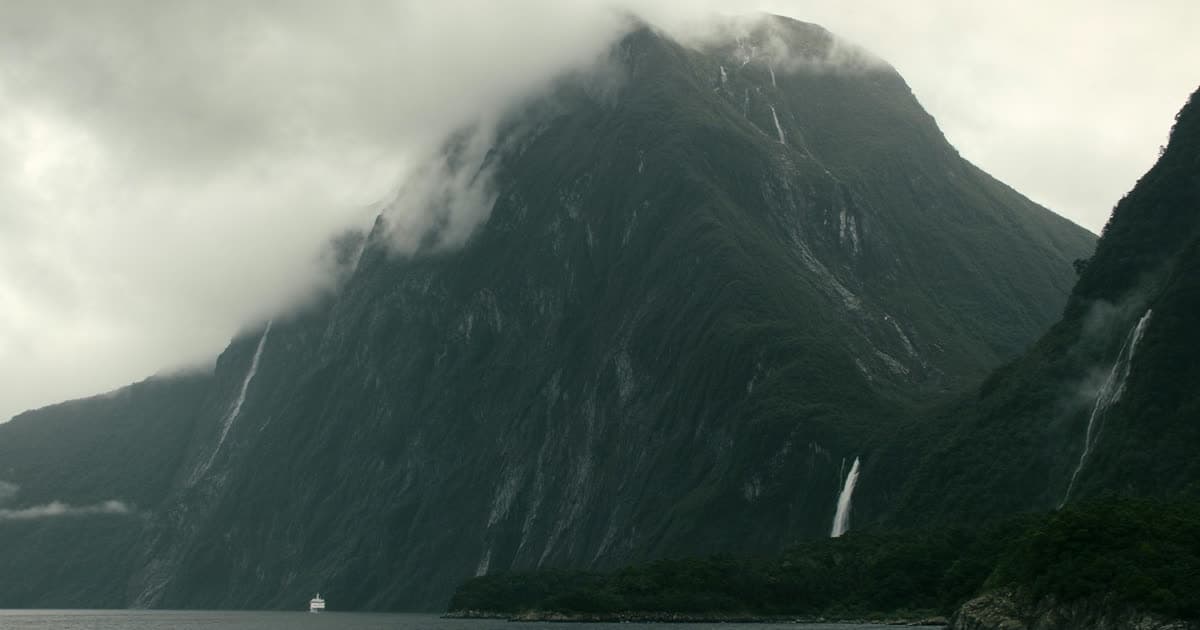
New Zealand is a scenic cruising destination first and a port destination second. The single best day of a New Zealand cruise is usually spent entirely on the ship, sailing into Milford Sound at dawn with cliffs rising 4,000 feet on either side and waterfalls dropping directly into the water beside the hull.
The catch is that Fiordland is one of the wettest places on Earth, receiving around 250 inches of rain a year, and entry into the sounds is at the master's discretion. Wind and swell close them regularly. Roughly one sailing in six misses at least one of the three sounds.
That is not a reason to avoid it. Fiordland in rain is arguably more dramatic than Fiordland in sun, because the waterfalls multiply. But do not build the trip around a single guaranteed photograph.
Most New Zealand cruises are twelve to fourteen nights and are combined with Australia, sailing between Sydney and Auckland across the Tasman Sea. Pure New Zealand circumnavigations of ten to twelve nights exist but are less common.
The country's geography spreads its ports widely, so itineraries carry more sea days than European equivalents. A fourteen-night Australia and New Zealand cruise typically has four to five sea days, including the two-day Tasman crossing.
New Zealand operates one of the strictest biosecurity regimes in the world. Hiking boots, tent pegs, walking poles and any soil-contaminated outdoor gear are inspected and may be cleaned or confiscated on arrival. Declare everything; the penalties for not declaring are severe and applied to cruise passengers as readily as to anyone else.
- Usually combined with Australia on twelve to fourteen night itineraries.
- Fiordland scenic cruising is the highlight and is weather-dependent.
- Four to five sea days on a typical fourteen-night itinerary.
- Strict biosecurity: declare all outdoor gear and footwear on arrival.
The best time to go
December through February is the southern summer and the warmest window. January and February have the most settled Fiordland conditions, which matters more than air temperature.
October and April are considerably cheaper and carry more weather risk in the sounds. March is our reviewers' quiet recommendation: settled weather, autumn light and fares below the peak.
| Month | Temperature | Fiordland conditions | Fares | Verdict |
|---|---|---|---|---|
| October | 58 to 65F, changeable | Variable, higher cancellation risk | Lowest | Cheapest, with real weather risk |
| November | 62 to 69F | Improving | Moderate | Good value, spring landscape |
| December | 66 to 73F | Good | High | Peak season begins |
| January | 70 to 76F, warmest | Best of the season | Highest | Warmest and most reliable |
| February | 70 to 76F | Best of the season | High | Equal best month, slightly quieter |
| March | 66 to 72F, settling | Good | Moderate | Our quiet recommendation |
| April | 60 to 67F, autumn | Deteriorating | Low | Good value, shorter days |
The ports, honestly assessed
New Zealand ports are mostly small and walkable, with the notable exception of Christchurch, which is a 45-minute transfer from its port at Lyttelton.
Milford SoundNew Zealand
Scenic cruising, not a port. Mitre Peak rises 5,551 feet directly from the water. Be on deck by 6am; ships usually enter at dawn.
Doubtful SoundNew Zealand
Larger and quieter than Milford, with three arms. Often the more atmospheric of the two.
Dusky SoundNew Zealand
The largest and most remote of the three sounds. Entered less often because of its length.
AucklandNew Zealand
The terminal is in the centre at Princes Wharf. Waiheke Island is a 40-minute ferry and the best day out.
WellingtonNew Zealand
The port is a 15-minute walk from the centre. Te Papa museum is free and excellent; the cable car is a five-minute walk.
Lyttelton for ChristchurchNew Zealand
A 45-minute transfer to Christchurch. The rebuilt city and the Banks Peninsula are both worthwhile.
Dunedin via Port ChalmersNew Zealand
30 minutes to Dunedin. The Otago Peninsula albatross colony is the best wildlife excursion in the country.
TaurangaNew Zealand
Gateway to Rotorua's geothermal area, 90 minutes inland. Mount Maunganui is walkable from the pier.
NapierNew Zealand
An art deco town rebuilt after the 1931 earthquake, walkable from the pier. Hawke's Bay wineries are 20 minutes.
PictonNew Zealand
The Marlborough Sounds gateway. Marlborough wine region is 25 minutes and the sounds cruise is excellent.
Bay of IslandsNew Zealand
A tender port at Waitangi. The Treaty Grounds are historically central and a short walk from the tender pier.
Weather, month by month
New Zealand weather is changeable and maritime. The South Island is cooler and wetter than the North; Fiordland is in a category of its own for rainfall.
| Month | High | Low | Sea | Rain days | Notes |
|---|---|---|---|---|---|
| October | 62F | 49F | 57F | 12 | Spring, changeable. Snow still on the Southern Alps. |
| November | 66F | 53F | 60F | 11 | Improving and good value. |
| December | 70F | 57F | 63F | 10 | Peak season begins. Long daylight hours. |
| January | 73F | 60F | 66F | 9 | Warmest month and best Fiordland conditions. |
| February | 73F | 60F | 67F | 9 | Warmest sea. Equal best month with January. |
| March | 69F | 57F | 66F | 10 | Settled autumn weather and softer fares. |
| April | 64F | 52F | 63F | 11 | Autumn colour, shorter days, best value. |
What it actually costs
New Zealand fares are similar to Australia's, and like Australia the dominant cost for North Americans is the flight, which runs $1,500 to $2,600 return to Auckland.
Most itineraries are open-jaw, flying into Sydney and out of Auckland or the reverse, which adds a few hundred dollars over a simple return.
| Cost item | Budget | Mid-range | Premium |
|---|---|---|---|
| Cruise fare, per night | $98 to $140 | $165 to $230 | $270 to $440 |
| Line and cabin | Royal Caribbean or Carnival, interior | Princess or Celebrity, balcony | Cunard, Oceania or Silversea |
| Open-jaw flights from North America | $1,600 to $2,800 | $1,600 to $2,800 | $1,600 to $2,800 |
| Pre and post hotels, four nights | $440 to $700 | $700 to $1,150 | $1,150 to $2,000 |
| Taxes and port fees | $300 to $440 | $320 to $480 | $340 to $520 |
| Gratuities | $154 to $224 | $238 to $294 | Often bundled |
| Excursions | $400 self-guided | $1,000 to $1,700 | $1,400 to $2,400 |
| Realistic total | $4,300 to $6,700 | $6,200 to $9,400 | $8,200 to $13,000 |
Popular itineraries
New Zealand itineraries come in four shapes, and the majority combine the country with Australia.
Australia and New Zealand, fourteen nights
from $2,310 per person
14 nights from Sydney or Auckland
Calls: Melbourne, Hobart, Fiordland, Dunedin, Wellington, Auckland
Best for: The standard and best value itinerary
New Zealand circumnavigation, twelve nights
from $2,160 per person
12 nights from Auckland
Calls: Bay of Islands, Tauranga, Napier, Wellington, Fiordland, Dunedin, Picton
Best for: Depth in New Zealand alone
New Zealand and South Pacific, sixteen nights
from $2,720 per person
16 nights from Auckland
Calls: Fiordland, Wellington, Noumea, Port Vila, Fiji
Best for: Combining fiords and tropical islands
Tasman crossing, ten nights
from $1,650 per person
10 nights from Sydney to Auckland
Calls: Fiordland, Dunedin, Wellington, Tauranga, Three sea days
Best for: One-way with a reposition flight
Grand Pacific, twenty-eight nights
from $4,620 per person
28 nights from Sydney or Los Angeles
Calls: New Zealand, Fiji, Samoa, Hawaii
Best for: Repositioning voyages in April and October
Travel tips from our sailings
Be on deck by 6am for Fiordland. Ships usually enter Milford Sound at dawn and it is the single best hour of the cruise.
Accept that Fiordland entry is weather-dependent. Roughly one sailing in six misses at least one sound, and no line will compensate for it.
Declare all hiking boots, walking poles and outdoor gear at New Zealand biosecurity. Undeclared soil-contaminated items carry heavy fines.
The Otago Peninsula albatross colony from Port Chalmers is the best wildlife excursion in the country and is often overlooked.
Te Papa museum in Wellington is free, world class and a 15-minute walk from the ship.
Book Rotorua from Tauranga only if geothermal scenery is a priority; it is a 90-minute transfer each way.
New Zealand weather changes fast. Pack a shell even in January; a Fiordland morning can be 50 Fahrenheit with rain.
New Zealand requires an NZeTA for most nationalities, applied for online before travel.
New Zealand packing essentials
- A waterproof shell, which you will use in Fiordland regardless of the month.
- Layers; New Zealand can deliver four seasons in a single port day.
- Clean hiking boots if you plan to walk, since biosecurity inspects and may clean dirty footwear.
- Factor 50 sunscreen; the ozone layer over New Zealand is thin and UV is severe.
- Binoculars for Fiordland waterfalls, dolphins and the albatross colony.
- A Type I power adapter, shared with Australia.
- Insect repellent for sandflies, which are genuinely aggressive in Fiordland.
The full list, including the banned-items rules, is in our cruise packing guide.
Terms worth knowing
- Fiordland
- A national park on New Zealand's southwest coast containing Milford, Doubtful and Dusky Sounds, where cruise ships spend a full day scenic cruising.
- Scenic cruising
- Time spent sailing through notable landscape rather than in port. In New Zealand it is the itinerary highlight rather than a filler activity.
- NZeTA
- The New Zealand Electronic Travel Authority, required by most nationalities including cruise passengers and obtained online before travel.
- Biosecurity
- New Zealand's strict border controls on organic material. Hiking boots, walking poles and outdoor gear must be declared and may be inspected or cleaned.
| Sound | Length | Character | How often entered | Standout |
|---|---|---|---|---|
| Milford Sound | 9 miles | Narrow, sheer, dramatic | Most often | Mitre Peak, 5,551 feet from the water |
| Doubtful Sound | 25 miles | Larger, three arms, quieter | Often | Scale and silence |
| Dusky Sound | 25 miles | Largest, most remote | Least often | Wildlife and isolation |
Which New Zealand cruise should you book?
New Zealand is a scenic cruising destination, so the itinerary structure matters more than the ports.
An Australia and New Zealand itinerary
Choose it when: You are flying from North America. Fourteen nights amortises a $2,000 flight far better than ten.
Sail January to March
Choose it when: Fiordland matters to you. These months have the most settled conditions and the lowest cancellation rate.
A circumnavigation
Choose it when: You want New Zealand alone rather than as half of an Australian trip, and you value more port calls over the Tasman crossing.
Book an ocean-view or balcony
Choose it when: You are cruising New Zealand at all. Fiordland day is spent entirely on the ship, and it is worth having your own space.
Sail October or April
Choose it when: Value is the priority and you accept a higher chance of missing a sound to weather.
Price New Zealand sailings
Realistic mid-range trips run about $195 per person per night all-in. Check current fares, then verify against the cost table above before booking.
Speak to a cruise specialist. Daily, 8am to 11pm ET.
New Zealand cruise questions
When is the best time to cruise New Zealand?
January and February have the warmest weather at 70 to 76 Fahrenheit and the most settled Fiordland conditions, which matters more than air temperature. March offers similar conditions with lower fares and fewer people. October and April are the cheapest but carry a noticeably higher chance of Fiordland being closed to shipping.
Is Milford Sound always included on a New Zealand cruise?
It is scheduled but never guaranteed. Fiordland receives around 250 inches of rain a year and entry is at the master's discretion based on wind and swell. Roughly one sailing in six misses at least one of the three sounds, and cruise lines do not compensate for it because it is a safety decision rather than a service failure.
How much does a New Zealand cruise cost?
Fourteen-night balcony fares run $165 to $230 per person per night, so $2,310 to $3,220 for the cruise. Open-jaw flights from North America run $1,600 to $2,800. A realistic mid-range total including hotels, port taxes, gratuities and excursions is $6,200 to $9,400 per person.
Do you need a visa for a New Zealand cruise?
Most nationalities, including US and Canadian citizens, need an NZeTA, the New Zealand Electronic Travel Authority, obtained online before departure. Cruise passengers are not exempt. It also carries an International Visitor Levy. Apply at least a week before travel; processing is usually fast but not instant.
What is New Zealand biosecurity like for cruise passengers?
Strict, and applied to cruise passengers the same as to air arrivals. Hiking boots, walking poles, tent pegs and any gear carrying soil must be declared and may be inspected, cleaned or confiscated. Fresh food, seeds and plant material are prohibited. Undeclared items carry instant fines, so declare anything you are unsure about.
How many sea days are there on a New Zealand cruise?
Typically four to five on a fourteen-night Australia and New Zealand itinerary, including the two-day Tasman Sea crossing. New Zealand's ports are widely spaced, so sea days are structural rather than filler. A twelve-night circumnavigation has fewer, usually two or three.
About the author
Ports and Destinations Writer
Lena Hartley covers the parts of a cruise that happen off the ship: departure port logistics, shore excursions, weather windows and whether a port call is worth leaving the ship for at all.
48 sailings logged across 8 cruise lines.
This page was fact-checked by Captain Alberto Ruiz, marine and operations reviewer, on . Prices and policies are re-checked against cruise line sources at least every 90 days. Read our editorial policy.